Showing posts with label 2009. Show all posts

Tuesday, August 23, 2011

GMC Sierra Hybrid Crew Cab, 2009

 
 GMC Sierra Hybrid Crew Cab, 2009

GMC announced the 2009 GMC Sierra Hybrid, a powerful full-size pickup that achieves 40-percent greater city fuel economy and a 25-percent improvement in overall fuel economy while delivering the capability expected of a full-size truck - including a 6,100-pound (2,767 kg) towing capacity.

Partnering General Motors' patented two-mode hybrid system and a powerful 6.0L gas V-8, the Sierra Hybrid delivers highly efficient performance, including all-electric driving up to 30 mph (48 km/h). That allows fuel savings to be realized even when the truck is fully loaded or towing a trailer.

The GMC Sierra Hybrid goes on sale in the fourth quarter of 2008 and is based on the strong and capable Sierra platform that was introduced for the 2007 model year. It will be offered in the Crew Cab body style on both 2WD and 4WD models. Each model is equipped with several standard, popular features, including StabiliTrak electronic stability control system, a locking rear axle and a trailering package. Sierra Hybrid also offers dual-stage frontal air bags and head curtain side air bags, and it is the only full-size truck with five-star side-impact ratings in federal crash tests.

Hybrid details
The Sierra Hybrid's fuel-saving performance is derived from GM's advanced Electrically Variable Transmission (EVT) and 300-volt nickel-metal hydride Energy Storage System (ESS), which work in concert with the standard 6.0L V-8 gasoline engine with Active Fuel Management (AFM) and late intake valve closing (LIVC) technology. GM's hybrid technology system not only enables the Sierra to launch and drive up to 30 mph on electricity alone, it also allows the Vortec 6.0L V-8 engine to operate in its more economical V-4 mode for longer periods.

As part of the vehicle's emission control system, the ESS is warranted for eight years/100,000 miles.

With GM's two-mode hybrid system, the electric power used to propel the vehicle is generated by the hybrid system itself. When the brakes are applied or the vehicle is coasting, the electric motors within the hybrid system create electricity that is stored in the 300-volt battery. This stored energy is used to move the vehicle and the regenerative braking cycle is renewed.

The two-mode hybrid system provides seamless, dependable power on demand in an efficient package. In fact, its electric motor is less than half the size of those in single-mode hybrid systems. This technology was developed and is still used in fleets of hybrid transit buses in more than 70 North American and European cities. Scaled-down for use in passenger vehicles, the two-mode system delivers fuel savings where it is needed most - in large vehicles with high levels of capability. The two-mode system was first introduced on the 2008 Yukon Hybrid. It is a core part of GM's energy diversity efforts, which are centered on reducing dependence on petroleum, improving fuel economy, reducing emissions and minimizing the automobile's impact on the environment.

With the fuel savings of the hybrid system and Sierra's 26-gallon (98-liter) fuel tank, the Sierra Hybrid has a cruising range of more than 500 miles (800 km).

Quiet and smooth
Integration of the hybrid system on the Sierra is seamless - the battery pack is located beneath the rear seat - and perceptible only in what it lacks: noise.

Contributors to the quiet driving experience:
    New exhaust system and resonator tuned for the 6.0L engine's Active Fuel Management operation
    Additional engine intake induction tuning for reduced interior noise and pleasing sound quality
    Low-rolling resistance, "quiet-tuned" P265/65R18 tires for reduced road noise
    Electrically driven 300-volt air conditioning compressor reduces vibration and allows the standard, tri-zone HVAC system to cool the passenger compartment even when the gasoline engine is shut off
    Electrically driven 42-volt variable-assist power steering reduces vibration and provides up to a 0.5-mpg fuel economy improvement by reducing parasitic losses common in belt-driven hydraulic systems
    Energy Storage System (ESS) cooling system internal fan is tuned to be quiet at low vehicle speeds when the fan could more easily be heard by the occupants

Trailering performance
In addition to increased fuel economy, the GMC Sierra Hybrid's electrically variable transmission also provides tremendous trailering capability, enhancing driving smoothness and quality when towing. Electric drive is enabled up to approximately 30 mph (48 km/h), even when towing, allowing fuel savings when the truck is towing a trailer.
The EVT incorporates grade braking and tap up/tap down shift control. It also benefits towing on curves or lower-speed back roads, as exceptionally smooth gear transitions eliminate the "shift shock" torque disruption that can occur during abrupt shifts, such as when slowing or braking.

Monday, May 16, 2011

Jeep Wrangler Unlimited EV, 2009

Jeep Wrangler Unlimited EV, 2009


The Jeep Wrangler Unlimited EV is a Range-extended Electric Vehicle that provides a glimpse into the future of a "Go Anywhere, Do Anything" vehicle with renowned Jeep Wrangler capability.

The Jeep Wrangler Unlimited EV prototype is a two-wheel drive Wrangler. However, Chrysler's ENVI organization is exploring four-wheel-drive, in-wheel electric motors to demonstrate the full reach of the Company's advanced electric-drive technologies. When this technology is developed by ENVI, the instant high torque of the electric-drive motor and the ability to precisely control each wheel independently will result in off-road capability ideally suited for the Jeep brand, without compromising on-road capability.

The Wrangler Unlimited EV also uses an ENVI Range-extended Electric Vehicle powertrain, consisting of an electric motor, an advanced lithium-ion battery system, and a small gasoline engine with an integrated electric generator to produce additional energy to power the electric-drive system when needed. The electric motor produces 200 kW (268 horsepower) and 400 N•m (295 lb.-ft.) of torque. The Jeep Wrangler Unlimited EV has a range of 400 miles, including 40 miles of zero fuel-consumption, zero-emissions, all-electric operation.

Saturday, May 14, 2011

Pontiac G6 Coupe, 2009

Pontiac G6 Coupe, 2009


Pontiac has announced that it is ringing in the new year with a fresh look for its best-selling line of G6 mid-size vehicles. Additional fuel-saving powertrain options, more aggressive exterior styling, and a sleek new instrument panel highlight the 2009.5 model Pontiac G6, which will begin arriving in the dealerships in January 2009.
All Pontiac G6 models, including sedans, coupes and convertibles, receive the interior upgrades. The uniquely styled Pontiac G6 GXP models will not be affected by the exterior or powertrain changes.

New Powertrain Options
For the first time, the Pontiac G6 coupe will be available with GM's fuel sipping, 164-horsepower 2.4L four-cylinder Ecotec engine. Linked to a six-speed automatic transmission, the coupe's new powertrain combo is capable of the same 33 miles per gallon fuel efficiency as the current Pontiac G6 sedan and also incorporates a new TAPshift manual shift system with steering wheel-mounted paddle controls.

In those areas where E85 ethanol-based fuel is readily available, a FlexFuel version of the 219-horsepower 3.5L V6 will be available as a no-cost alternative to the standard 3.5L engine on all body styles.
The optional 222-horsepower 3.9L V6 for the Pontiac G6 convertible remains unchanged, as does the standard 252-horsepower 3.6L V6 in all GXP models.

Sportier Exterior
Inspired by the sporty front end styling of the new Pontiac G8 performance sedan, the new G6 front fascia features chrome surrounds for the signature Pontiac dual port honeycomb grille. This same grille pattern is carried to an updated lower air dam.

Also new are a revised headlight design with clear park/turn lenses and amber lamps, body color mirrors and painted rockers on the sedan and coupe. An updated spoiler is available for base model sedans and is standard on the GT models.
New rear fascias unique to the sedan and coupe/convertible accommodate both single and dual exhaust, as well as larger diameter exhaust tips.

17-inch chrome wheel covers are now standard equipped on all four-cylinder, six-speed automatic sedans and coupes. An updated 17-inch wheel will be standard as a part of the popular Sun-and-Sound package.

Refreshed Interior
A revised center stack is the most obvious interior enhancement of the 2009.5 model Pontiac G6, sporting all new HVAC controls and an updated AM/FM/CD/MP3 radio with auxiliary audio input jack. The driver information center has moved to the gauge cluster, which has also been enhanced with new graphics and lighting.

The 2009.5 Pontiac G6 will also benefit from the integrated info-tainment opportunities in GM's optional MY LINK enhanced communication package. MY LINK integrates audio system, Bluetooth telephone, XM satellite radio and OnStar navigation functions in one simple package. It includes an upgraded USB-equipped radio system, allowing for direct control of various portable music players, plus provides a full year of both XM radio and OnStar Directions and Connections services.

Other interior changes include new dark satin nickel trim accents on the steering wheel, door panels, and shifter plate. New two-tone seats in an ebony-light taupe color combination are available in either cloth or leather for all models, offering an option to the standard ebony seats. A new optional ebony-titanium color leather seating package is also available on all GT and GXP models.

Pontiac G8 GXP, 2009

Pontiac G8 GXP, 2009

 
Pontiac announced the flagship of its GXP performance series, the Pontiac G8 GXP high-performance sedan, at the 2008 New York Auto Show. This 2009 model will join the Solstice, G6 and Torrent GXP models in Pontiac dealerships in late 2008. The Pontiac G8 GXP takes the G8's responsive driving experience, refined passenger environment and aggressive good looks to a new level. It also delivers an enjoyable driving experience, thanks to a 6.2L V-8 that produces in excess of 400 horsepower.

Engine performance
The heart of the Pontiac G8 GXP is the 6.2L LS3 small-block V-8, currently rated at 402 horsepower (300 kW) and 402 lb.-ft. of torque (546 Nm) pending final SAE certification. This engine is the newest member of GM's small-block V-8 family. It features a revised, larger-bore cylinder block, high-flow, L92-style cylinder heads; larger-diameter pistons; unique camshaft and camshaft timing; revised valvetrain with offset intake rocker arms; high-flow intake manifold; and high-flow fuel injectors.

The LS3 engine has an aluminum cylinder block with cast-in-place iron cylinder liners. Larger bores help create a 376-cubic-inch displacement. The block casting also features revisions and machining in the bulkheads to enhance its strength and improve bay-to-bay breathing. New pistons were designed for high-rpm performance.

New, high-flow cylinder heads aid engine breathing and are based on the large port and valve design found on the LS7 engine and other GM L76 engines. The larger-capacity, straighter intake port-design optimizes intake flow to the combustion chamber, an effect augmented by large valves, measuring 2.16 inches (55.0 mm) on the intake side and 1.59 inches (40.4 mm) on the exhaust side.

Pending final testing, the Pontiac G8 GXP is expected to deliver 0-to-60 mph performance of about 4.7 seconds, and a quarter-mile time of 13.0 seconds at 108 mph.

Six on the floor
A new six-speed Tremec TR6060 manual transmission is optional on the Pontiac G8 GXP. This next-generation manual smoothly transfers the engine's power and torque to the rear wheels with a reduction in shift throw. The transmission features a host of refinements including premium gear synchronizers; stronger gears, housing, and bell housing; a single-piece counter shaft; and machined gear teeth.

The standard Hydra-Matic six-speed 6L80 automatic transmission is technologically advanced and robust. It uses a clutch-to-clutch operation and an integrated 32-bit transmission controller to deliver smooth and precise shifts. The six-speed has a generous 6.04:1 overall ratio that enables a "steep" first-gear. The result is strong launch acceleration along with "tall" overdrive ratios that lower engine rpms for better fuel economy and reduced noise.

A 3.27 final drive ratio comes with automatic-equipped GXPs, and a 3.70 gear is matched with the manual transmission. A limited-slip differential is standard.

High-performance suspension
The Pontiac G8 GXP rides on the G8's 114.8-inch (2915 mm) wheelbase with wide front (62.7 inches / 1,592 mm) and rear (63.3 inches / 1,608 mm) tracks. The four-wheel independent suspension is fully adjustable and is tuned for the highest performance in the G8 family. The GXP's ride and handling was developed and validated on racetracks and highways around the world, including the famed Nürburgring racing circuit. It rewards the driver with sharp, immediate responses, as well as a well-balanced road feel during spirited driving.

The suspension employs a MacPherson strut design in the front and a four-link, coil-over-shock design in the rear. A direct-acting front stabilizer bar, decoupled rear stabilizer bar and lateral ball joints on the rear suspension deliver increased lateral stiffness for more responsive handling. The front suspension features fully adjustable caster, camber and toe; the rear suspension has fully adjustable camber and toe, for more precise tuning.

Steering and brakes
The steering rate for the GXP is tuned to provide immediate response with definitive driver feedback. Like the G8 sedan and GT, the GXP's steering box is located ahead of the front axle line for a quicker, more direct feel.

The Brembo braking system matches the GXP's boost in performance with an equivalent increase in stopping power. The system includes 14-inch (355 mm) vented front and 12.76-inch (324 mm) rear disc rotors, with special quad-piston alloy calipers in front. The alloy calipers on the rear brakes have single-piston actuation. The four-wheel disc brake system includes standard anti-lock brakes and traction control.

Wheels and tires
The GXP rides on 19-inch polished aluminum wheels with a special machined face. Performance-oriented summer P245/40R19 tires are standard, and a comparable all-season tire is available. Combined with the suspension and steering enhancements, this setup gives the GXP exceptional cornering grip.

Exterior styling
The Pontiac G8 GXP exhibits strong Pontiac design cues. A unique front fascia with a lower splitter and a distinctive rear fascia diffuser contribute to its sporty look. The dual-port grille, fog lamps, bold wheels and confident, wheels-at-the-corners stance are all unmistakably Pontiac traits.

Interior amenities and comfort
The Pontiac G8 GXP's interior is driver-oriented with aesthetic and tactile details like instruments with a sporty appearance that match the car's performance. Interior materials consist of satin and chrome trim and high-quality textured materials throughout. The instrument cluster glows with crisp, white light on the primary instruments. Pontiac's signature red lighting illuminates the rest of the instrument panel cluster.

Standard comfort and convenience amenities include:
    * Highly bolstered two-tone sport seats with color-coordinated gauge cluster and GXP embroidery
    * Leather-trimmed steering wheel and gear shifter
    * Power-adjustable front seats
    * Fog lamps
    * Alloy sport pedals
    * A 230-watt Blaupunkt audio system
    * XM Satellite Radio

The seats offer firm support to hold occupants in place during aggressive cornering. The standard heated leather seats were designed to deliver excellent comfort during long drives. They are available in Ebony or an Ebony/Red two-tone.

Safety
    * Maintaining the G8's tradition of a full suite of standard safety features, the Pontiac G8 GXP includes:
    * Four-wheel disc brakes with ABS and traction control
    * Electronic stability control
    * Seat-mounted thorax air bags and dual-stage frontal air bags for front passengers, with automatic passenger sensing system
    * Roof rail side-impact air bags for both seating rows
    * OnStar

Monday, May 9, 2011

Scion iQ Concept, 2009

Scion iQ Concept, 2009


At the 2009 New York Auto Show, Scion unveiled a special concept version of the Scion iQ micro-subcompact car designed to meet the transportation needs of young urban trendsetters.

Scion iQ concept is a new urban vehicle with a revolutionary package that is just over 10 feet in length and accommodates three plus luggage. As more and more urban centers are revitalized with a new sense of purpose, energy, and creativity, young people are moving in from the suburbs to embrace new urbanism and are looking for a car that suits their needs and delivers high emotional value.

Scion iQ concept is the intelligent answer to this need for highly emotional and efficient urban transportation. The convenience of having work, entertainment and culture nearby for young city-dwellers is a significant draw to urban centers. The vehicle must be able to navigate narrow, congested streets, park in tight places, have impressive fuel economy, and have compelling design and function.

The production Scion iQ is currently sold in Japan and Europe. Five Axis of Huntington Beach, Calif. took the Scion iQ to the next level with aggressive exterior and interior modifications that show the vehicle's potential for personalization.

With its 78.7-inch wheelbase, the three-door hatchback can deftly maneuver through city traffic. At the same time, its overall length of 126.9-inches, overall width of 71.4-inches, and short front and rear overhangs allow the Scion iQ to fit in virtually any city parking space. The front-mounted differential and repositioned steering rack decrease front end length. In addition, the Scion iQ is equipped with a flat gas tank housed beneath the floor that reduces rear overhang.

Pushing the wheels of the small, bold concept towards the four corners of the body gives the Scion iQ a confident stance. The custom 18-inch wheels with a nickel finish and wide tires fill the wheel well, adding to its surefootedness. The Scion iQ's custom front air dam, aero headlamps and high-intensity LED driving lamps signal urban road readiness.

The Scion iQ's profile is defined by a strong and high beltline. Smooth lines glide from the large, dark finish headlamps, up the A-pillar, across the roof and wrap around the rear emphasizing the concept's geometric beauty. Side mirrors with integrated turn signals accent the clean design.

The rear emphasizes the vehicle's modern style. Trapezoidal lines run toward the wheels, from the hatch to the thick rear diffuser, creating a substantial presence. A center-mounted trapezoid exhaust adds to the vehicle's distinctiveness, while large, matte-finished rear taillights help keep the vehicle visible.

The Scion iQ's interior fuses function, style and entertainment. Attention to detail and modern accents can be seen in the illuminated door handle; the swiveling spotlight that hovers over the dash; an illuminated Scion iQ logo on the passenger-side dash and nickel and raw aluminum toned interior panels. Iridescent green and gray honeycomb upholstery covering the door panels and seating areas, combined with the custom exterior paint, provides a balance of freshness and sophistication. Black matte scuba-like polyurethane covers the seat bolsters and is also used on the headliner with a bright green topstitch for a contemporary finish.

The Scion iQ features a 10-inch panel LCD screen on top of the center cluster that serves as the main entertainment console and navigation system interface. With the push of a button, the touch-screen articulates to reveal the entertainment hub. The touch screen can also play movies while the vehicle is parked. When not in use, the screen lays flat on the dash with a translucent cover that emits a colorful display of light patterns to make the interior even more unique.

A few quick strokes to the black panel below the entertainment hub, or steering wheel controls, command the audio system to shuffle through a music library. The center cluster also features three control knobs for dual front heating and air conditioning settings. The driver and front passenger each have a knob that displays their desired temperature and controls their temperature and fan settings. The center knob dictates zone control for both occupants.

The instrument panel has a speedometer, warning lamps, and a multi-information display. The multi-information display allows the driver to toggle through the odometer, average speed, temperature and eco lamp. The eco lamp illuminates during efficient driving to help the driver achieve maximum fuel economy.

Comfortable front passenger legroom was achieved with a newly-engineered, compact air conditioning unit located behind the center of the front console. The Scion iQ employs a glove bag, with the same textured, honeycomb fabric as the front and rear seats, that can be easily snapped on and off for storage or additional legroom.

Rear seating can accommodate one adult behind the front passenger and a child, small package, or pet behind the driver. Extra slim front seat backs provide rear passengers with legroom. The rear seats are 50/50 and fold flat for increased utility. In addition, the rear seat cushion lifts up to reveal a small flat storage space that can be used for pocket-sized portable music players, small books, digital cameras, or slim laptops.

The Scion iQ does not skimp on safety and is equipped with Vehicle Stability Control (VSC); an anti-lock brake system (ABS) with Electronic Brake force Distribution (EBD); Brake Assist (BA); and nine SRS airbags, which includes the world's first rear window curtain airbag. Other airbags include driver and front passenger front airbags; driver and front passenger seat-mounted side airbags; side curtain airbags; a driver knee airbag; and a front passenger seat cushion airbag.

POWERTRAIN
    * Engine: 1.3-liter, four-cylinder, VVT-i
    * Horsepower: 93 hp
    * Torque: 89 lb.-ft.
    * Drivetrain: Front wheel drive

DIMENSIONS (inches)
    * Overall Length: 126.9
    * Overall Width:
          o 71.4 without side mirrors
          o 79.3 including side mirrors
    * Overall Height:
          o 56.9 without antenna
          o 62.5 including antenna
    * Wheelbase: 78.7
    * Seating Capacity: 3+1

MODIFICATIONS
    * Exhaust: Five Axis custom stainless exhaust
    * Wheels: Five:AD S6:F custom wheels with nickel finish prototyped by MetalFX 18x8.5 ET03
    * Tires: Yokohama S.drive 2.5/40R18
    * Suspension: TEIN Super Street coilover suspension
    * Body:
          o Five Axis widebody conversion
          o Burnt nickel accents
          o Custom accented headlights and taillights

Wednesday, May 4, 2011

Chrysler GEM Peapod, 2009

Chrysler GEM Peapod, 2009


Clean and green transportation gets a new look and feel as GEM, a Chrysler LLC company, introduces the next generation of clean, gas-free and emission-free, battery electric vehicles.

The vehicle's innovative, groundbreaking design, with its striking pod-like shape and sleek lines, reflects the environmentally friendly nature that has been the hallmark of GEM since its founding 10 years ago.

The user-friendly mood of the vehicle, named the GEM Peapod, is enhanced with the newly designed center console that will offer iPod integration, as well as hands-free operation of the customer's iPhone. Other innovations include ergonomic, supportive, mesh seating, which enables air circulation for comfort and uses eco-friendly recycled and recyclable materials.

The Peapod represents the first in a series of product launches that will redefine the future of electric vehicles, said the company's CEO Bruce Coventry.

GEM cars are in six models: two-, four- and six-passenger cars and three utility vehicles. GEM neighborhood electric vehicles have a top speed of 25 miles per hour, a range of up to 30 miles per charge (battery charge is extended through use of regenerative braking) and are street legal in more than 40 states. The vehicles can be recharged anytime, anywhere with a standard 110-volt outlet. Recharge time is approximately six to eight hours.

By replacing conventional vehicles, GEM vehicles can reduce overall emissions of pollutants, particularly during short trips when conventional vehicles create the most tailpipe emissions. GEM vehicles have been driven a combined 200 million miles and averted more than 150 tons of pollutants from reaching the air, while saving 10 million gallons of gasoline.

Caterham R500, 2009

Caterham R500, 2009


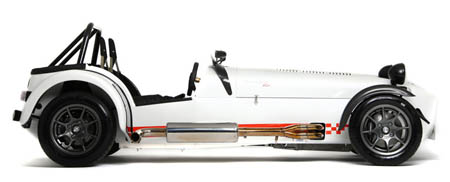
For those really serious about their driving, the famous supercar-slaying R500 moniker is back with the arrival of the all-new Caterham Seven Superlight R500.
The latest model from the British sportscar manufacturer takes the minimalist, lightweight Seven philosophy to a new level with more power, sharper handling and for those venturing on track the option of launch control and the Caterham Motorsport engineered sequential gearbox.
Weighing just 506kg and producing 263bhp, Caterham R500 is the most potent race-tuned production Seven yet.

The Series 3 chassis flagship model blasts out 520bhp-per-tonne and is capable of propelling itself from 0-60mph in 2.88 seconds, delivering a pure adrenalin fix for those committed enough to strap themselves into the Kevlar race seats.

The original Caterham R500 was legendary, with the old Rover K-series powered machine rewriting performance records for 0-60mph and 0-100-0mph times. This new variant has been equipped to supersede its predecessor by embracing the very latest in lightweight engineering techniques and technology.

Lurking under the lightened bonnet is the all-alloy 2.0 litre Ford Duratec engine. Fed by its roller barrel throttle bodies, the normally aspirated, four-cylinder mill is tuned by Caterham Powertrain (CPT) to unleash a monster; 263bhp with a heaving 177 lb-ft of torque transmitted to the rear wheels. The relentless acceleration is transmitted through each ratio by either the standard 6-speed gearbox or the optional Caterham Motorsport engineered sequential transmission.

To help reign in such extreme performance are race-developed Avon CR500 tyres and a suspension set-up that includes weight saving aero wishbones and fully adjustable dampers. Bringing things ferociously to a halt are four-piston calipers clamping on vented discs at the front and lightweight twin piston rear calipers.

Performance upgrades for the Caterham R500 aimed squarely at the track day market include a sequential transmission, launch control, a gulping Carbon Induction Airbox and Eibach Springs and dampers derived from the Caterham C400 race series.

The Caterham R500 isn't just about big performance statistics though; refinements and Seven firsts feature throughout and help distinguish it from its stablemates.
In true Colin Chapman spirit, engineers sought to add lightness to the chassis in order to improve the overall performance.

To shed a massive 9kg from the already featherlight chassis utilised by the R400, Caterham left no bolt unscrewed - more carbon and Kevlar feature than previously, thinner body panels have been utilised right through to aluminium rear light housings.
Discreet exterior styling tweaks carried over from the flagship CSR models offer both form and function - the carbon winglets increasing downforce and the cat's tongue grill aiding cooling and aerodynamics. A carbon leather boot cover and clear rear lights are also new.

Housed within the revised chassis is keyless ignition, a quick-release Momo steering wheel with integrated indicator switches and an innovative dashboard featuring flush fitted switchgear, ACES sequential gear change lights and a new Stack display with scrolling text. The carbon dash is also finished with a detailed engraved plaque to show each car's number.
On sale immediately, the factory built Superlight R500 starts at £36,995.

Breckland Beira, 2009

Breckland Beira, 2009


Norfolk-based Breckland - part of Hong Kong-based multi-national, Riche Holdings - is vastly experienced in the development and production of high-quality, low volume specialist cars and prototypes for an array of prestigious international clients, including Mosler, and has now employed its substantial skills in the making of its own limited-production supercar.
The Breckland Beira is a hand-built, two-seat roadster with unique styling cues, tuned to produce just a whisper short of 400bhp.

Tipping the scales at some 1,400kg, the Beira's impressive power-to-weight ratio ensures invigorating performance, with the promise of a sub-five second sprint to 100kph, coupled with tremendous torque and a governed top speed of 155mph.

Beira dynamics
Breckland Beira is based on the well-developed General Motors Kappa platform, on sale in the North American market.
Breckland Beira differs in many significant respects from the GM products however, the most radical departure being the installation of the potent, 6.0-litre, LS2 V8 engine, more commonly found in Corvette and Pontiac GTO models. It replaces the four-cylinder Ecotec engine and, by comparison, produces more than twice the power of the original unit.

The mighty, fuel-injected, aluminium V8 and Tremec six-speed manual gearbox are neatly packaged under the Beira's swooping bonnet, with a bespoke wiring harness and ECU, the latter being reprogrammed to allow the V8 to deliver close to 400bhp, combined with a dual-fuel capability.
Other key considerations involved significant attention to chassis dynamics, to ensure the car corners, steers and brakes effectively with the significant increase in engine output.

To satisfy this requirement, the fully independent suspension was entirely re-engineered by Breckland in association with KW Suspension, with uprated springs, dampers and bushes, plus thicker anti-roll bars front and rear. The result is slightly less suspension compliance, but a more focused ride and handling.
Stopping power is provided by impressive, 325mm ventilated discs on all four corners, the fronts being grasped by six-pot callipers, with four-pot at the rear, both from UK specialists, HiSpec.
Steering is via power-assisted rack and pinion, whilst the dramatically styled 18" cast alloy wheels are 8.5" front and 9.5" rears, shod with Bridgestone ultra-low profile tyres. Customer options include an upgrade to 19" diameter rims and tyres.

Exterior packaging
In order to make the Breckland Beira eye-catchingly different, save weight and liberate additional luggage space behind the passenger compartment, Breckland's design engineers have totally re-modelled both the front and rear body sections in-house, using lightweight composites instead of steel, the result being a highly distinctive nose section and pronounced fastback rear.

Bespoke interior
Breckland Beira features a custom-built interior, including electric windows, air conditioning, twin airbags - in the steering wheel and in the passenger dash - combined with clear, concise instrumentation, and hand-stitched leather/Alcantara seats and trim.

Affordability
The Breckland Beira is designed very much as a high-quality low-volume, affordable sportscar for enthusiasts, and follows the highly appealing tradition of installing an easily available, American-designed V8 engine in a small, nimble, two-seater chassis to produce an exhilarating, high-performance package. Although using a tried and trusted concept, however, Beira is very much a vehicle for the 21st century, and accomplishes this with both environmental and fuel efficiency concerns in mind.

Thursday, April 28, 2011

Suzuki Grand Vitara, 2009

Suzuki Grand Vitara, 2009


 The vehicle's surprising off-road performance is matched by an equally impressive interior, making the Grand Vitara the perfect choice for adventure-minded drivers seeking to confidently explore the outside world in comfort and style. The ultimate discovery vehicle, the Suzuki Grand Vitara helps customers engage directly with their environment and their experiences.

For 2009, the rugged and award-winning Suzuki Grand Vitara, a true SUV in a segment of "soft-roaders," offers "brute-ute" owners the opportunity to resize for better fuel economy without settling for a "cute-ute" lacking full SUV capability. A standard, all-new four-cylinder engine provides drivers with better mileage, and a new, more powerful V6 delivers fuel economy better than the V6 it replaces.

Performance and Functionality
The new Suzuki-developed 2.4-liter four-cylinder engine produces 166 horsepower and 162 lb.-ft. of peak torque, delivering EPA fuel economy estimates of up to 19 mpg/city and 26 mpg/highway. Available for Suzuki Grand Vitara XSport and Luxury models is a new 3.2-liter V6 engine with 230 horsepower and 213 lb.-ft. of torque, replacing the 2.7-liter V6 engine in 2008 Grand Vitara that produced 185 horsepower and 184 lb.-ft. of torque. Despite an increase of 45 horsepower, the new V6 betters the old motor in fuel economy ratings. The new engine is also 20 percent cleaner than the 2008 model as measured by the State of California's smog index rating. The new V6 also features variable valve timing for both the intake and exhaust camshafts, and both Suzuki Grand Vitara engines use a zero-maintenance timing chain in place of a belt.

The Grand Vitara's new four-cylinder engine can be teamed to a standard five-speed manual transmission or a new four-speed automatic transmission, while the V6 is matched to a standard five-speed automatic transmission. To help fulfill their sense of adventure, customers can choose among RWD models, Single-Mode four-wheel drive or Four-Mode full-time four-wheel drive, a traction system unlike anything else offered in the segment. The Electronic Stability Program (ESP®) is standard for all Suzuki Grand Vitara models, along with a new rollover sensor for the standard side curtain airbags. Enhancing performance on any road is a strengthened structure for 2009, plus rear disc brakes that replace the previous drums.

Suzuki Four-Mode four-wheel drive offers the best of both worlds: further aided by a completely retuned suspension, it is exceptionally capable off-road but is civilized on the asphalt. On pavement, drivers can leave the dash-mounted transfer case switch in 4H and the electronically controlled on-demand four-wheel-drive system will apply traction to the front wheels only as needed, optimizing economy. When traveling off-road, or for low-speed power and traction, drivers can turn the switch to high-range 4H Lock or low-range 4L Lock to engage the center differential lock. The V6 models with Four-Mode full-time four-wheel drive also feature Hill Descent Control and Hill Hold Control, which can enhance driving safety on steep slopes.

Built Like a Brute
The Suzuki Grand Vitara continues Suzuki's 40-year heritage of building compact but rugged SUV-type vehicles, including a model named "Brute." The current Grand Vitara has proven its durability in some of the toughest global markets. Key to the Grand Vitara's go-anywhere capability is its unibody construction with integrated ladder frame, rear-drive-based driveline and four-wheel independent suspension. Typically, only luxury SUVs offer this premium architecture. This type of construction yields the strength and capability sought in large SUVs, while providing the on-road agility and ride quality expected in a modern compact SUV.

Also separating the Suzuki Grand Vitara from the "high wagons" in the segment is the availability of a Four-Mode full time four-wheel-drive system with two-speed transfer case. This hardware, combined with its rugged body construction, steep approach and departure angles, and 7.9 inches of ground clearance (4WD models), enables the Grand Vitara to keep going when the pavement turns to trail. In addition, the Suzuki Grand Vitara 3,000-lb. towing capacity (with V6) is double that of many car-based models and enough to haul light recreational boats, ATVs or motorcycles.

Suzuki Alto, 2009

Suzuki Alto, 2009


At the 2008 Paris Motor Show, Suzuki has unveiled the all-new Suzuki Alto — the fifth and smallest member of its acclaimed lineup of world strategic models. The new Suzuki Alto combines eye-catching style and easy urban mobility with great performance in terms of fuel efficiency and CO2 emissions, thereby meeting the lifestyle needs of today's motorists and the pressing global need for environmental compatibility. Plus, it is one of the most fun-to-drive city cars available — a great new example of Suzuki's "Way of Life!" philosophy.

As the second model in the second phase of Suzuki's world strategy (a phase that's focused on user-friendliness and delivering expanded possibilities for family members), the new Suzuki Alto offers good levels of comfort and convenience within a modest overall length.
Plus, a design that combines sporty, European-inspired looks with great aerodynamics means the new Suzuki Alto is the most stylish car of its size.

The new Suzuki Alto reflects the unparalleled knowledge of small-cars that has made Suzuki so successful with minivehicles in Japan and compact cars like the Swift all over the world. Suzuki Alto is a definitive response to the need for enjoyable, eco-friendly motoring. Suzuki aims to achieve annual sales of 60,000 units in Europe following a sales launch in spring 2009.

The new Alto is aimed mainly at urban people who want a small car that offers style and enjoyment together with great environmental credentials, and it reflects the ideals of the second phase of Suzuki's world strategy. At the heart of the concept for the new Suzuki Alto is Suzuki's belief that people should be able to enjoy economical, eco-friendly motoring without sacrificing style, comfort, practicality, or performance. Compact dimensions (the new Suzuki Alto is the smallest of Suzuki's world strategic models) play a large part in realising outstanding environmental credentials by keeping weight to a minimum, but without detracting from user-friendliness.

Design, Comfort and Practicality
The new Suzuki Alto has a sporty, solid look that exudes urban energy despite the body's compact dimensions. The design is elegant and beautiful thanks to aerodynamically efficient contours that combine tautness with evocative curviness. It is ideally matched to European tastes and with a drag coefficient of just 0.30 promotes fuel efficiency and low CO2 emissions.

The cabin layout apportions most of the space to the front seats but still provides ample space for four adults. Handy storage spaces for small items are located all around the cabin. Notwithstanding the new Alto's compact exterior dimensions, there's a usable amount of luggage space behind the rear seats, and folding down the rear seatback expands the space into a roomy luggage area suited to daily use.

Performance and Environmental Compatibility
The new Suzuki Alto is powered by a three cylinder 1.0-litre petrol engine successfully launched as an engine of the Suzuki Splash. This unit is light and compact with low friction characteristics. Maximum power output is 68PS (50kW) with maximum torque of 90Nm. Fuel consumption is low at 62.7 mpg on the combined cycle and CO2 emissions are just 103g/km. Standard transmission is a five-speed manual and a four-speed automatic transmission (uncommon among one-litre cars) with gate-type shifter is available as an option.

Suspension
The front suspension is of MacPherson strut type and the large, high-rigidity suspension frame is complemented by further strengthening in the strut mounting areas for superior handling. The rear suspension has Suzuki's proprietary 3-link rigid axle design, and incorporates numerous refinements for the new car. The coil springs and dampers were tuned for optimum handling stability through extensive testing on roads in Europe.

Suzuki targeted handling that makes driving enjoyable on urban roads, so drivers enjoy linear response, gentle roll movements, light steering feel, and good absorption of shock and vibration. These benefits reflect the experience Suzuki has gained in motorsport around the world.

Safety
To help the driver avoid hazards on the road, the new Suzuki Alto is available with Electronic Stability Program (ESP®), which modulates the engine performance and applies the brakes during cornering and under aceleration.

In the unfortunate event of an accident, the new Suzuki Alto's body reflects Suzuki's Total Effective Control Technology (TECT) concept in the form of crushable structures that absorb impact energy, frame members that disperse impact energy away from occupants and a strong cabin structure. Use of high-tensile steel for major body parts means the resulting high level of occupant safety does not add excessive weight to the body.

SRS front, side, and curtain airbags are available to reduce the severity of impacts suffered by occupants in the event of a collision. Energy-absorbing trim materials provide further head protection.

Spyker C8 Laviolette LM85, 2009

Spyker C8 Laviolette LM85, 2009


Spyker introduces the Spyker C8 Laviolette LM85 of which a maximum of 24 production slots are being offered. The LM85 has been designed in the spirit of the Spyker Squadron GT2 (LMES) race cars and sports a GT2 inspired livery. The Spyker C8 Laviolette LM85 is named after the starting number of the GT2 cars Spyker has had at Le Mans since 2002.

The Spyker C8 Laviolette LM85 specification list is exhaustive with exclusive elements incorporated. All 24 LM85 owners are special guest during the 24 Hours of Le Mans in June 2009. Furthermore, a special Chronoswiss 24 Hours Pilot Watch is part of the offer.

The Spyker C8 Laviolette LM85 is an advanced mid-engine, two-seat sports car. It is characterized by a lightweight all aluminium body construction and an uncompromising engineering package. The powertrain of the Spyker C8 Laviolette LM85 is the all aluminium Audi 4.2 Litre V8 engine producing 400 bhp. This is paired to a manual six-speed Getrag gearbox, driving the rear wheels with a Drexler limited slip differential. The use of aluminium parts and other lightweight materials results in an impressive power-to-weight ratio and underlines the GT2 racing heritage of the LM85.

Based on the Spyker C8 Laviolette GT2R, the racing characterisitics of the LM85 are numerous, such as the structural aluminium chassis, GT2 livery (Burnt Almond Orange with Gun Metal 'S' logo), side mirrors in gun metal, a carbon fibre rear spoiler, and GT2 windscreen streamer. Behind the black powder coated alloy wheels, black AP Racing 6 piston brake calipers with AP Racing logo appear.

The ample use of black leather and alcantara, which is originally meant to reduce light reflection during racing, has been finished with orange contrast stitching and characterizes the unique interior of the Spyker C8 Laviolette LM85.

On request, Chronoswiss dials and switches can be installed and are virtually identical to the Chronoswiss 24 Hours Pilot Watch every LM85 owner receives with his car. The black floor mats are made of fire protective material, finished with orange piping and the LM85 logo embroidered.

Pilot Watch
Every Spyker C8 Laviolette LM85 owner receives a special edition Spyker Chronoswiss 24H Pilot Watch with orange crocodile strap. The serial number of the car will be engraved on the case of this exquisite time piece.